Hauptsturmführer Michael Wittmann
|
Rank |
Hauptsturmführer (SS Captain) |
|
Name & Decorations |
Michael Wittmann |
|
Service |
Schützstaffel (SS) |
|
Unit |
1st SS Panzer Division Leibstandarte SS Adolf Hitler (LSSAH) |
|
Attached To |
Not applicable |
|
Operations |
Operation Barbarossa (Invasion of Russia) Battle of Kursk Normandy Campaign |
|
Date of Death |
8th August 1944 |
|
Place of Death |
Saint-Aignan-de-Cramesnil, Normandy |
|
Circumstances |
Killed in Action |
|
Age |
30 |
|
Buried or Commemorated at |
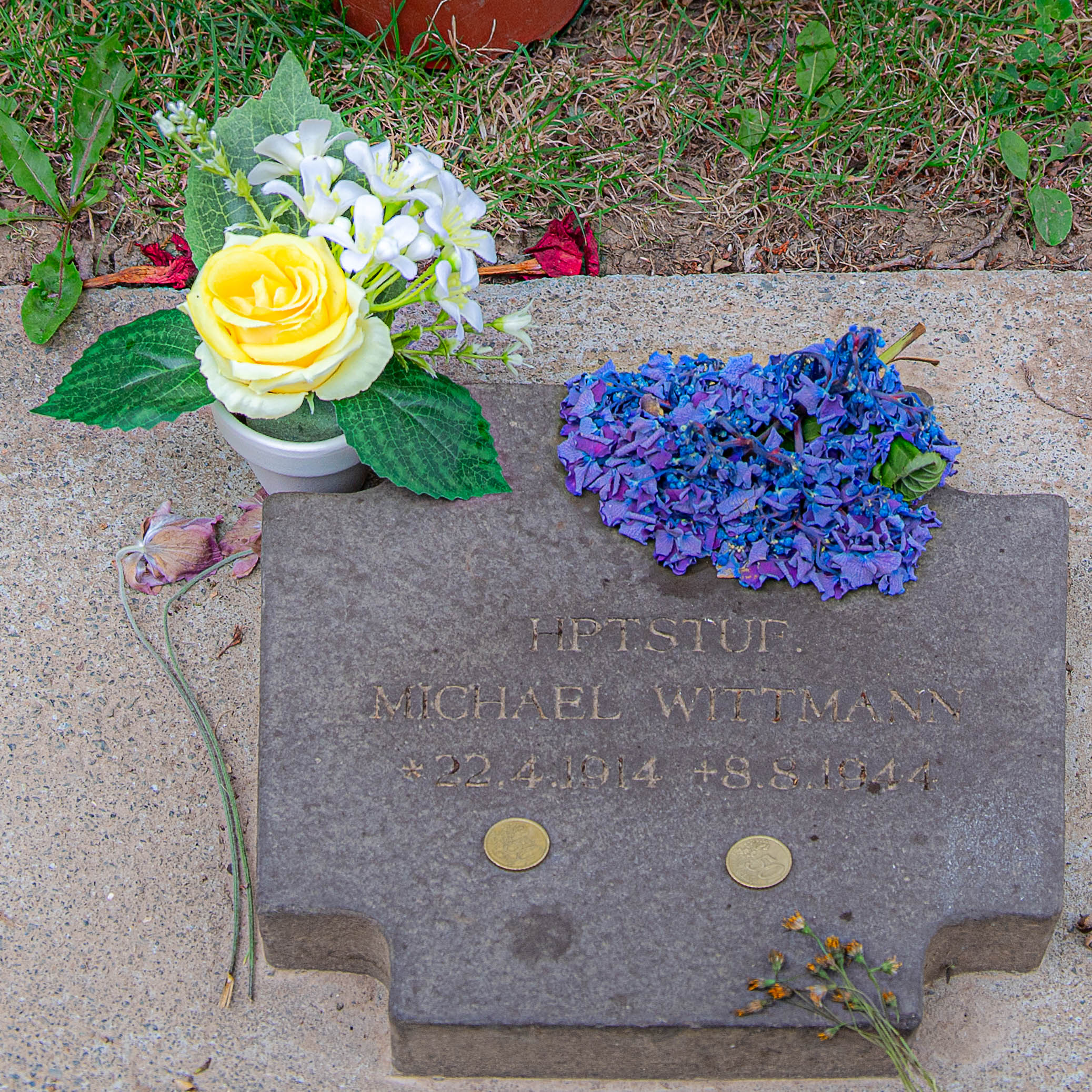
Battlefield grave, reinterred 1983 La Cambe Deutsche Soldatenfriedhof, Normandy |
|
Grave or Memorial Number |
Block 47: Row 3: Grave 120 |
Michael Wittmann was a famous German tank commander during World War 2. Whilst there are differing opinions as to his tactical skill, with some historians describing his 'bold' attacks on British armour as tactical folly which resulted in a 'lucky' victory, most accounts portray him as a tactically proficient and skillful commander.
Wittmann was born in the Bavarian village of Vogelthal near Dietfort on 22nd April 1914. He joined the Heer, the German Army, at about 19. In October 1936 Wittmann joined the SS (Schützstaffel), joining the Leibstandarte SS Adolf Hitler regiment, (which was later expanded to become a full SS division, abbreviated as the LSSAH), in April 1937
Wittmann took part in many famous operations, such as the annexation of Austria and the occupation of the Sudetenland, the invasion of Russia, the Battle of Kursk, and later the famous Normandy campaign defending against the Allied invasion and ensuing battles.
Wittmann rose through the ranks, being promoted to a platoon commander and later company commander of the renowned Tiger heavy tanks.
In April 1944, the LSSAH's Tiger Company was transferred under command of SS Heavy Panzer Battalion 101 and assigned as a Corps asset of the 1st SS Panzer Corps, under General Sepp Dietrich. As a Corps asset it was controlled at Corps level and not assigned to a regular tank regiment or division. Wittmann was promoted SS Obersturmbanführer and appointed commander of the 2nd battalion.
.jpg "Four tanks move down a tree lined lane in open country.")
During the Anglo-American advance south from Gold and Utah beaches, Wittmann's battalion was the only reserve unit available to General Dietriech to reinforce the crumbling German defences.
Wittmann's company was positioned around the strategically-important town of Villers-Bocage to block the British advance. However the company was at half strength, 6 tanks instead of 12 due to a combination of combat losses and unserviceability. On the 13th June, the leading elements of the British 7th Armoured Division entered Villers-Bocage, intending to exploit the gap in the front line by seizing Villers-Bocage and the high ground of the nearby ridge (Point 213) in an attempt to force a German withdrawal. Wittmann was caught on the hop as he had expected the British to take longer to arrive, and he hadn't had enough time to prepare proper defensive positions, stating "Instead I had to act quickly, as I had to assume that the enemy had already spotted me and would destroy me where I stood."
He set off with one tank, ordering the rest of his company to stand fast. At c0900 hours Wittmann's tank outflanked the British column and destroyed the rearmost tanks around point 213. Moving back towards the village, Wittmann destroyed several transport vehicles, carriers and light tanks. Whilst the Britsh reacted, calling in some medium tanks, Wittmann destroyed another British tank, some artillery observation post tanks, a scout car and a half-track.

At this point, accounts start to differ as to what happened next, but generally historical records state that Wittmann continued eastwards to the outskirts of the town until his tank was hit and disabled by an anti-tank gun. Wittmann however recorded that his tank was disabled by an anti-tank gun, but in the town centre,
In less than a quarter of a hour, SS Heavy Tank Battalion destroyed;
c14 tanks
2 anti-tank guns
c15 transport vehicles;
most of which were accredited to Wittmann personally. For his actions, Wittmann was immediately promoted to SS Hauptsturmbannführer and awarded the prestigious Knight's Cross of the Iron Cross with Oak Leaves and Swords. The German propaganda machine portrayed the battle of Battle of Villers-Bocage as a major victory and Wittmann's reputation was further enhanced, having already become a household name.
Wittman's Death.
On 8 August 1944, British and Canadian forces launched an offensive to capture the high ground near the town of Saint-Aignan-de-Cramesnil, under the codename Operation TOTALIZE. Whilst the Anglo-Canadian forces were awaiting the commencment of an artillery bombardment prior to the next phase of the battle, the SS Divisional Commander Kurt Meyer ordered a counterattack to disrupt the Allies and recapture the strategically-important high ground.
Witttmann's unit of 7 Tiger tanks, supported by other tanks and infantry, crossed open ground heading towards the high ground. Here they were ambushed on two sides by allied tanks, from 'A' Sqn 1st Northampton Yeomanry and 'B' Sqn 144 Regiment Royal Armoured Corps from the northeast, and from the west by 'A' Sqn Sherbrooke Fusiliers Regiment (27th Canadian Armoured Regiment) located at a chateau courtyard broadside to the attack, where they had knocked firing positions through the stone walls.
The Canadian tanks destroyed two Tiger tanks, two Panzer IVs and two self-propelled guns in Wittman's force, and the British tank fire destroyed three other Tigers.
Anti-tank shells fired from the Canadian tanks penetrated the upper hull of Wittmann's tank, igniting the stored ammunition wth the resulting fire blowing off the turret and fire engulfed the tank. None of the crew, including Wittmann, survived, and they were buried in a battlefield grave. The unmarked grave lay undiscovered until 1983, when the German War Graves Commission located the grave site. Subsequently Michael Wittmann and his crew were exhhumed, and their bodies reinterred together at the Deutsche Soldatenfriedof at La Cambe.
From Wikipaedia (https://en.wikipedia.org/wiki/Michael_Wittmann
In 2008 a documentary in the Battlefield Mysteries TV series examined the final battle. A historian, Norm Christie, interviewed participants; Sydney Valpy Radley-Walters, Joe Ekins and Ken Tout, and from their testimony and the two German accounts pieced the final battle together. The Tigers left the cover of a hedge near Cintheaux at 12:30 in two prongs; one in the middle of the field with the other—including Wittman—moving more slowly on the right. The British 75mm armed tanks engaged the lead Tiger (Iriohn) hitting it in the transmission, bogies or track and it started going in circles trying to withdraw. Joe Ekins' tank hit the second Tiger on the right side and knocked it out. As the crew escaped and brought out their wounded, they watched another Tiger north of them go up in flames (Kisters). Iriohn partly withdrew but could not get away and was hit by Ekins—"the one that was mulling around." Wittmann signalled "Pull back!" He did not realize that a group of the Sherbrookes were immediately to his right, and in a volley they knocked out the two Tigers beside the road. The commander of the second Tiger recalled the position of Wittmann's tank and specifically the skewed turret. The tank blew up shortly afterwards. Hans Hoflinger in a following Tiger was also attacked by enfilading fire from Sherman Fireflies with powerful 17-pounder guns, and had to abandon his tank. He saw the fire and explosion in Wittmann's tank, and that the turret was displaced to the right and tilted down to the front somewhat. None of his crew had gotten out. Survivors from Dollinger's tank passed by the wreck of Wittmann's tank shortly afterwards.
In more recent years the 2008 Battlefield Mysteries documentary has been criticized on grounds of inaccuracy and standard of proof. It is largely based on the postulations put forward by Canadian writer Brian Reid's unsubstantiated claims made in 2005. Much of the show is based on speculation and is at odds with the first Investigation conducted by After The Battle military magazine published in 1985. It was After The Battle that were the first to investigate Wittmann's death and had documentary evidence from the War Diary of the 1st Northamptonshire Yeomanry. This only mentions 3 Tigers in the field, numbers 312, 007 and 314 and it does not mention the Sherbrooke Fusiliers who were supposed to be across the field. In a battle this would have been reported. The documentary has comments from Brig. General Radley Walters, which was in one of the Sherwood Fusiliers tanks. While his tank did not destroy any tanks, they saw the tanks passing by. He does remember a tremendous explosion. According to the documentary, there was a fourth tank, the 009 visible from Ekins position. It cannot be ruled out that a sloppy written 009 can be interpreted as 007 from the war diary.
Deutsche Soldatenfriedhof (Germany Military War Cemetery) La Cambe, Normandy, France.
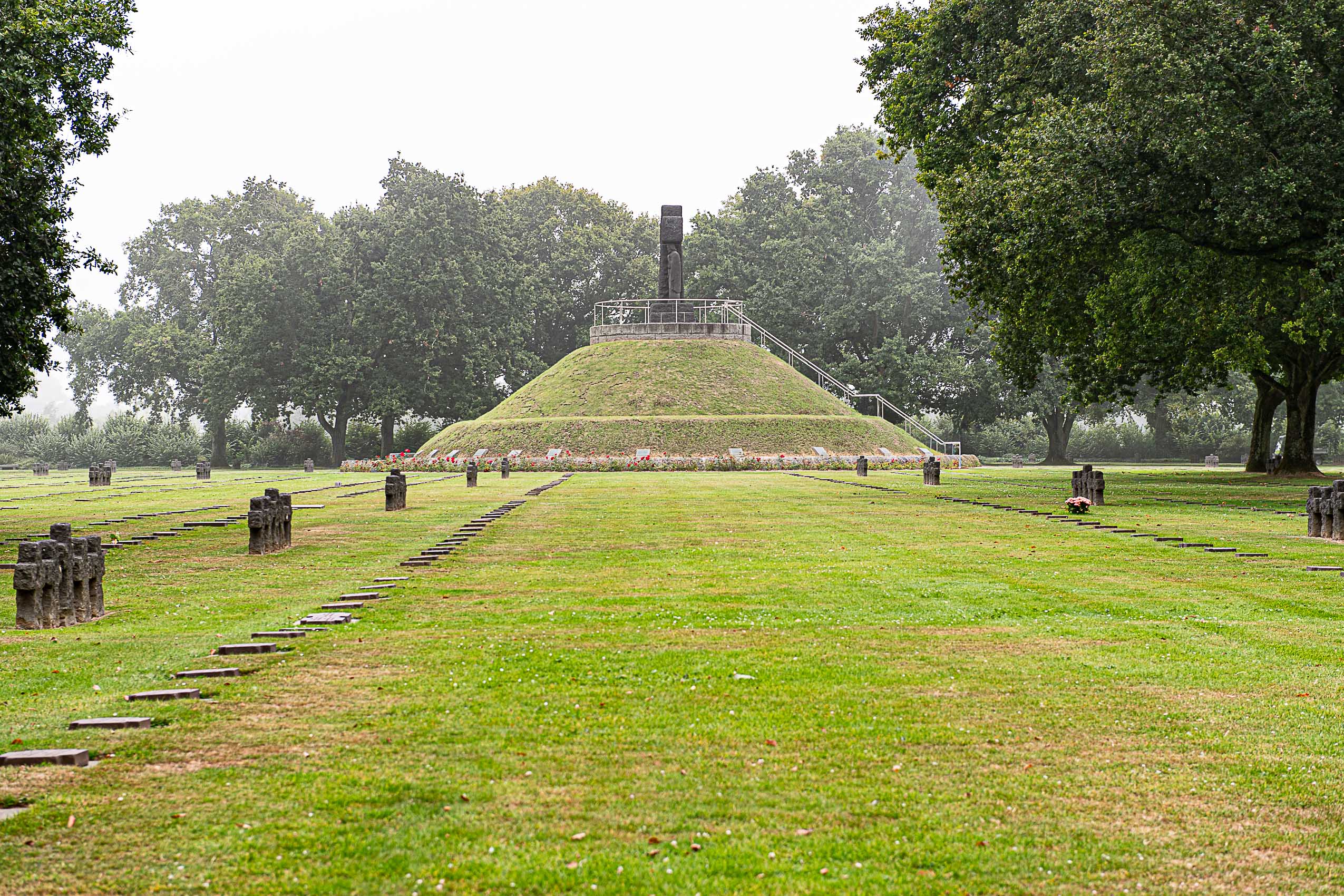
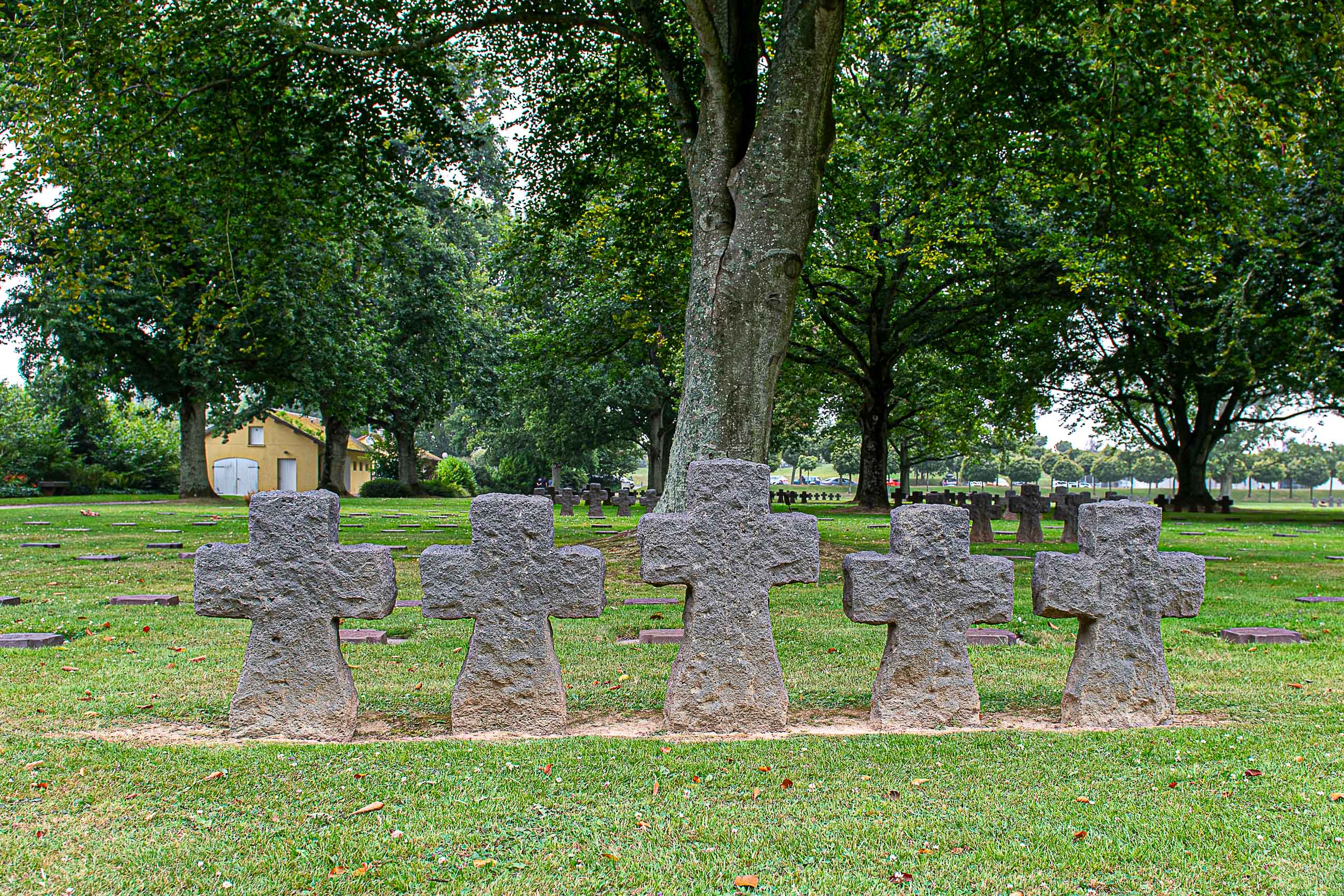
Link to my images of the German War Cemetery at La Cambe, Normandy.