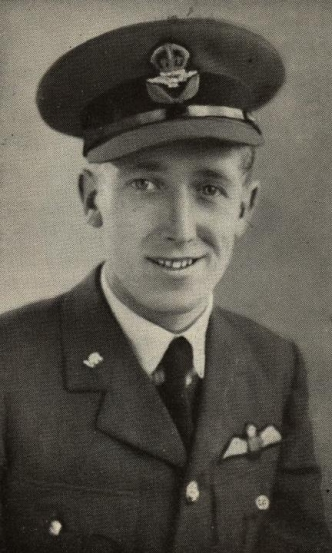
Pilot Officer Harold Edwin Penketh RAFVR
|
Rank |
Pilot Officer |
|
Name & Decorations |
Harold Edwin Penketh |
|
Service |
Royal Air Force Volunteer Reserve |
|
Unit |
No 266 Squadron RAF, stationed at RAF Wittering |
|
Attached To |
No 12 Group RAF Fighter Command |
|
Operation |
Training Flight: Pactice Section formation battle climb to altitude |
|
Date of Death |
22nd November 1940 |
|
Place of Death |
Holme Fen, Cambridgeshire |
|
Circumstances |
Killed on Action Service |
|
Age |
20 |
|
Buried or commemorated at |
Woodvale Crematorium and Cemetery, Brighton Ashes interred at St Peter's Church. |
|
Grave or Memorial Number |
Panel 3 |
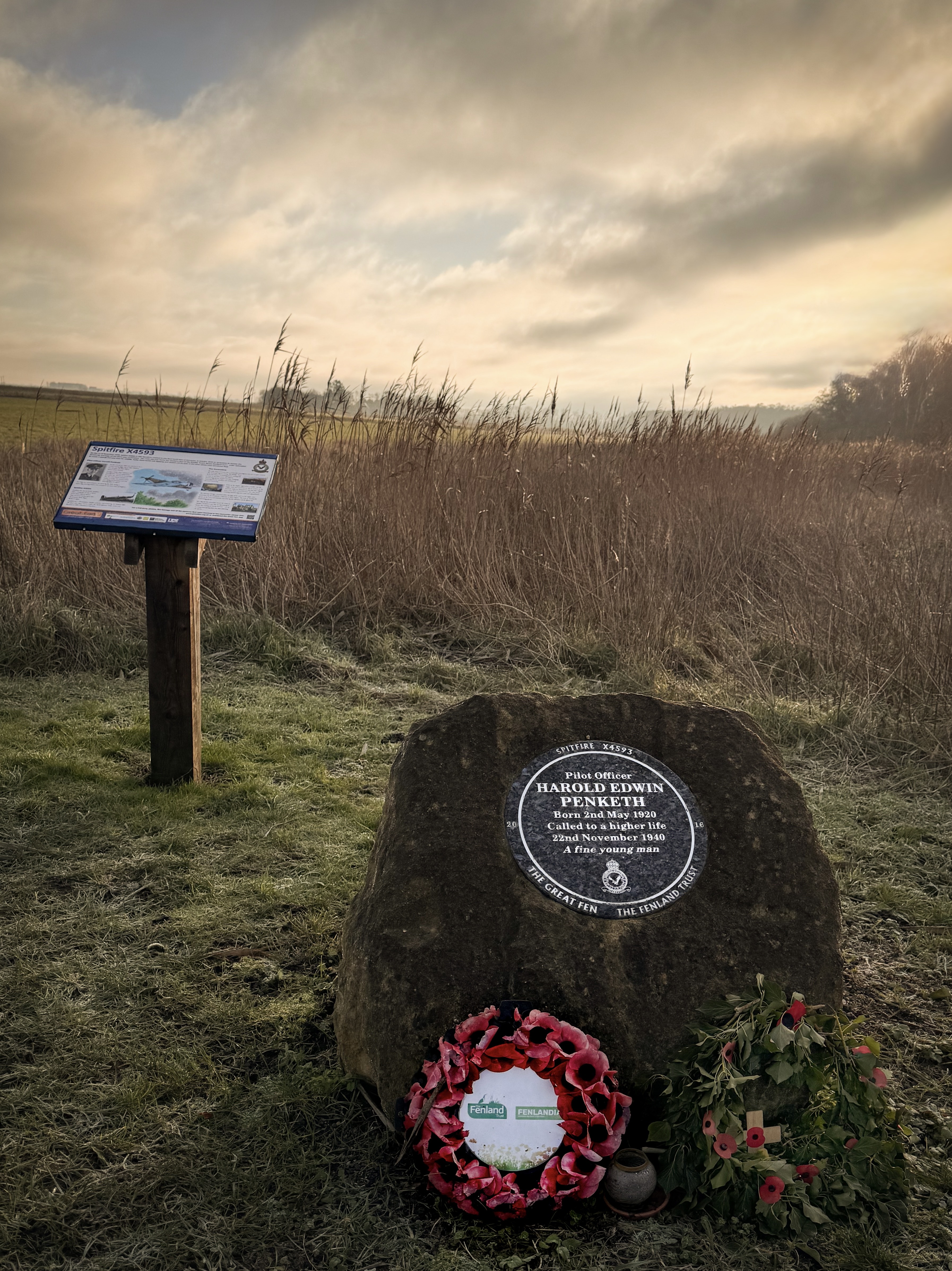
The image of the memorial at Holme Fen, Cambridgeshire, is with the kind permission of the copyright owner and photographer Natalie Elise Hough-Benns LRPS.
Source https://www.greatfen.org.uk/about-great-fen/heritage/
On 22 November, 1940 Spitfire X4593 of 266 Squadron crashed near Holme Lode Farm, Holme. At the controls for what was intended to be a routine training flight was Pilot Officer Harold Edwin Penketh. During a battle climb to altitude with two other Spitfires, he was seen to break formation entering a dive from which unfortunately he failed to fully recover. Witnesses stated that his aircraft partially recovered at around 2000ft but immediately re-entered a dive and struck the ground vertically.
Pilot Officer Penketh was not able to use his parachute and was killed in the resulting crash. Although he was a new pilot with 266 Squadron, based nearby at Wittering, with only some 13 hours experience on Spitfires, his Station Commanding Officer stated that he could fly it quite well and was fully conversant with the oxygen system. It was assumed that his oxygen system was working as he had reached 28,000ft without any apparent problem. Investigation concluded that either a failure of the oxygen system or a physical failure had occurred.
Harold Penketh’s body was recovered from the wreck of his Spitfire and returned to his home town of Brighton where he had previously worked for the Ocean Accident and Guarantee Corporation. His obituary in the staff magazine ended : “He was of a charming disposition and his loss was keenly felt by his family and those who knew him.” His name is recorded on a memorial at Brighton’s Woodvale Crematorium and Cemetery; he died aged only 20.
Excavation report
During October 5th to 11th 2015 Oxford Archaeology East, local community volunteers, and members of Operation Nightingale excavated the remains of Spitfire Mk Ia X4593 'Kerala' near Holme Fen in Cambridgeshire.
Spitfire X4593 crashed on the 22nd November 1940, on a routine training flight and Pilot Officer Harold E Penketh was killed. The official MoD records note that a recovery team excavated down to the aircraft in the week following the crash and recovered the remains of Pilot Officer Penketh. Evidence for this subsequent excavation and recovery of Pilot Officer Penketh was found, along with an RAF mess plate believed to have been left on the site by the recovery team as a marker.
Remains of the Spitfire, including the engine block and parts of the cockpit were found in-situ at a depth of -6.27m OD, along with other parts of the airframe (including .303 ammunition) that were within the area excavated during the recovery operation.
A note on findagrave.com states that "Recovered and restored remains of the plane are now at RAF Wyton Pathfinder Museum."
Eyewitness accounts
“The sky would be full of planes, I don’t know whether they gathered here or what, but there’d be hundreds of them all getting ready to go to Germany - Lancasters and that sort of thing - hundreds of them, the sky was full.
I saw the Spitfire that crashed just the other side of the woods; I was sitting on the front door step, it was in the sky and all of a sudden the engine stopped and it just spun round and went into the Fen ground, it just went straight in.”
T.Redhead
“I saw the Spitfire crash, I would be nine I guess; I was down Short Drove up a tree, several of us were there at the time. There were half a dozen Spitfires in the air above the village, and they were having a practice; suddenly this aircraft peeled away from the rest of them and came spiralling down. Then levelled out, then went straight in to the fen just the other side of the wood.
I didn’t think a great deal of it at the time, it was more excitement than being really upset because the pilot had died. I went down there with my father and the policeman - there was an enormous crater which was slowly filling up with water while we were there - at Holme Fen the water table is very high, and if you dig a hole it’s not very long before it fills up. There was quite a lot of steam coming out of the hole as obviously the engine was very hot. We had quite a lot of crashes around here, especially on the airfield, but when you’re very young you don’t feel the remorse of losing the pilot, but now I am older it was a very traumatic time and it was very sad. They died defending us.”
J.Bliss
The Plane
Spitfire registration number: X4593, built at Eastleigh, Hants as a Mark 1A Spitfire with a Merlin III engine. The plane flew in the Battle of Britain and is credited with destroying at least one German plane, believed to be a Heinkel. It was a presentation Spitfire paid for/named by the Madras Mail (English language daily evening paper, published 1868-1981), the first in a trio of Mark 1s named by their readers. The plane was called ‘Kerala’ (after the SW Indian state) and allocated to 266 Squadron, a Rhodesian squadron. The other two planes were X4594 ANDHRADESA and X4595 TOMILAND.
266 Squadron
266 Squadron became a Rhodesian fighter squadron within Fighter Command and went on to establish a fine reputation in the skies over western Europe. In October 1939 Sqn 266 was reformed as a fighter squadron at Sutton Bridge, flying Battles until they were supplied with Spitfires in early 1940. They moved to Martlesham Heath near Ipswich in March 1940, then to Wittering in May 1940, having been re-equipped with Spitfires. The squadron was active in the evacuation from Dunkirk, and flew coastal patrols and convoy escorts until fighting in the Battle of Britain in August and September 1940. Sqn 266 began an intensive operational training programme in September for the many new pilots, when patrols over the Thames Estuary permitted.
266 Squadron’s crest has a motto: Hlabezulu, meaning ‘The stabber of the sky’.