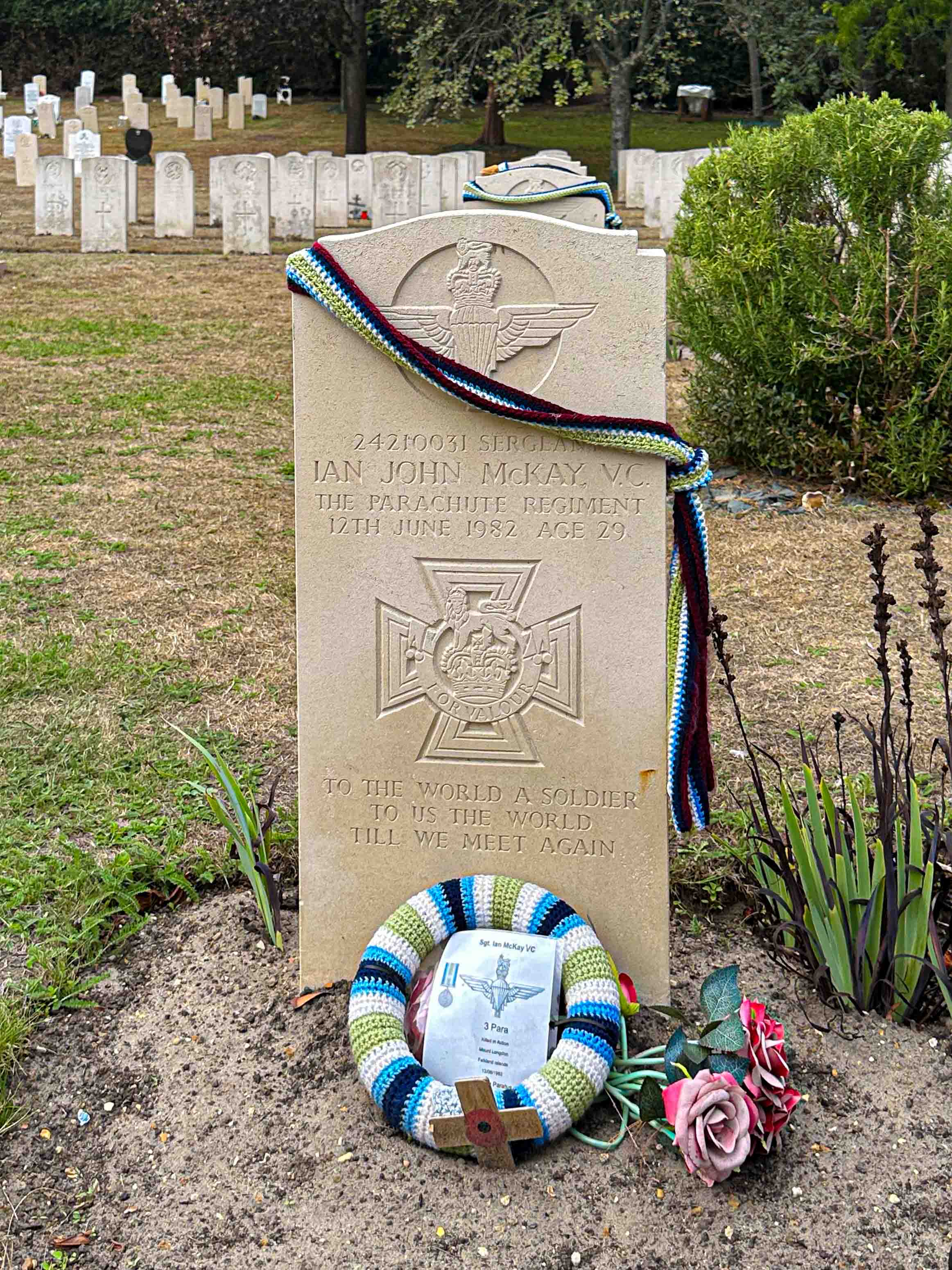
Sergeant Ian John McKay VC The Parachute Regiment
|
Rank |
Sergeant |
|
Name & Decorations |
Ian John McKay VC |
|
Service |
British Army |
|
Unit |
The Parachute Regiment |
|
Attached To |
4 Platoon, B Company, 3 Para (Platoon Sergeant) |
|
Operation |
Operation Corporate (Liberation of the Falkland Islands 1982) |
|
Date of Death |
12th june 1982 |
|
Place of Death |
Mount Longdon, East Falkland |
|
Circumstances |
Killed in action whilst single-handedly assaulting enemy positions |
|
Age |
29 |
|
Buried or Commemorated at |
Aldershot Military Cemetery, Aldershot, Hampshire |
|
Grave or Memorial Number |
Source : wikipedia https://en.wikipedia.org/wiki/Ian_McKay

Ian John McKay VC (7 May 1953 – 12 June 1982) was born in Wortley near Barnsley in South Yorkshire, the eldest of the three sons of Kenneth John McKay, a steel worker, and Freda Doreen Hargreaves. He was educated at Rotherham Grammar School, leaving school at 17 to join the Army, He trained as a paratrooper. before being posted to the 1st Battalion, the Parachute Regiment (1 Para) in early 1971, with whom he served in Northern Ireland, Germany, and the United Kingdom.
On 30 January 1972, whilst part of a patrol on the streets of Derry (Londonderry), McKay was involved in the killing of unarmed civilians in the event which became known as 'Bloody Sunday'. In the enquiries and official reports concerning the massacre he is referred to as Private T.
An inquiry concluded that McKay was likely responsible for firing the shot which wounded Patrick Brolly. However, McKay was cleared of any wrongdoing, as the the inquiry determined that he was the only soldier present who had not fired indiscriminately, had a valid reason to fire, and had not intended to shoot Brolly. The inquiry found that if he did fire the shots which wounded Brolly, he unintentionally hit him while aiming at another man who was throwing bottles containing acid at him.
Further postings followed, as is common in military careers, including a posting to the Depot the Parachute Regiment in Aldershot, from where he was posted to 3 Para as Platoon Sergeant of 4 Platoon, B Company. It was during this posting that 3 Para were deployed to the Falklands.
VC Citation.
During the night of 11th/12th June 1982, 3rd Battalion The Parachute Regiment mounted a silent night attack on an enemy battalion position on mount Longdon, an important objective in the battle for Port Stanley in the Falkland Islands. Sergeant McKay was platoon sergeant of 4 Platoon, B Company, which, after the initial objective had been secured, was ordered to clear the Northern side of the long East/West ridge feature, held by the enemy in depth, with strong, mutually-supporting positions. By now the enemy were fully alert, and resisting fiercely. As 4 Platoon's advance continued it came under increasingly heavy fire from a number of well-sited enemy machine gun positions on the ridge, and received casualties. Realising that no further advance was possible the Platoon Commander ordered the Platoon to move from its exposed position to seek shelter among the rocks of the ridge itself. Here it met up with part of 5 Platoon.
The enemy fire was still both heavy and accurate, and the position of the platoons was becoming increasingly hazardous. Taking Sergeant McKay, a Corporal and a few others, and covered by supporting machine gun fire, the Platoon Commander moved forward to reconnoitre the enemy positions but was hit by a bullet in the leg, and command devolved upon Sergeant McKay.
It was clear that instant action was needed if the advance was not to falter and increasing casualties to ensue. Sergeant McKay decided to convert this reconnaissance into an attack in order to eliminate the enemy positions. He was in no doubt of the strength and deployment of the enemy as he undertook this attack. He issued orders, and taking three men with him, broke cover and charged the enemy position.
The assault was met by a hail of fire. The Corporal was seriously wounded, a Private killed and another wounded. Despite these losses Sergeant McKay, with complete disregard for his own safety, continued to charge the enemy position alone. On reaching it he despatched the enemy with grenades, thereby relieving the position of beleaguered 4 and 5 Platoons, who were now able to redeploy with relative safety. Sergeant McKay, however, was killed at the moment of victory, his body falling on the bunker.
Without doubt Sergeant McKay's action retrieved a most dangerous situation and was instrumental in ensuring the success of the attack. His was a coolly calculated act, the dangers of which must have been all too apparent to him beforehand. Undeterred he performed with outstanding selflessness, perseverance and courage.
With a complete disregard for his own safety, he displayed courage and leadership of the highest order, and was an inspiration to all those around him.
After initial burial in the Falklands, Sgt Mckay was repatriated home to the UK, where he was re-buried with full military honours in the Falkands plot of Aldershot Military Cemetery.